

Rugby sevens looks familiar: two teams, an oval ball, tackles and tries. Then someone breaks into space, the defence scrambles, and the scoreboard changes within seconds. Seven players cover a full-sized pitch, matches are short, and restarts arrive quickly.
Understanding the rugby sevens rules makes the action easier to follow. Here is how the fast format works, what earns points and why its tactics differ from traditional fifteen-a-side rugby.
Rugby Sevens Basics: Teams, Pitch and Objective
Each team has seven players on the field rather than fifteen. The playing area is the same size as a standard rugby union pitch, creating more room for running and passing. Teams may nominate and use up to five replacements under World Rugby’s standard sevens laws, although competition arrangements should be checked.
The objective is to finish with more points than the opposition. Players can run with the ball, pass it backwards or sideways, and kick it forward. They cannot intentionally pass forward. A knock-on, when a player loses the ball forward in certain circumstances, commonly leads to a scrum.
Sevens retains rugby union’s tackle, ruck, offside and foul-play principles. The smaller teams simply make mistakes more costly because fewer defenders are available to cover them.
How Long Is a Rugby Sevens Match?
A standard match has two seven-minute halves, or fourteen minutes of scheduled play, plus time lost. Half-time lasts no longer than two minutes. A competition final may use halves of up to ten minutes, but the longer format is optional, not automatic.
The clock reaching seven minutes does not necessarily end a half immediately. Play can continue until the ball becomes dead, subject to the laws covering penalties and outstanding restarts. That is why a final attack sometimes extends beyond the displayed time.
When a knockout match needs a winner and finishes level, extra time can be played in periods of up to five minutes. The first score in extra time wins immediately: the golden-point rule.
Sevens Scoring: Tries, Conversions and Goals
Sevens scoring uses standard rugby union point values. A try earns five points when an attacker legally grounds the ball in the opponents’ in-goal area. A successful conversion adds two points. A penalty goal or drop goal earns three points.
Why conversions look different
After a try, the conversion must be a drop-kick, not a placed kick from a tee. It must be taken within thirty seconds of the try being awarded, measured in playing time. The kick is taken in line with the location of the try, so scoring near the touchline makes conversion harder.
For example, a try near the posts followed by a conversion earns seven points. An unconverted try earns five. That difference helps explain why a player sometimes runs towards the posts after crossing the try line instead of grounding the ball near the corner.
Kick-offs and Restarts: A Key Sevens Rule
One distinctive sevens match rule surprises first-time viewers: after a score, the scoring team takes the restart. In fifteen-a-side rugby, the opponents normally restart after conceding points.
The restart is a drop-kick from on or behind the centre of halfway, normally taken within thirty seconds of the conversion being taken or declined. Team-mates must stay behind the kicker. The ball generally must reach the opponents’ ten-metre line unless an opponent plays it sooner. Certain errors award a free-kick to the other team.
Watch after a converted try. The scorer may chase a carefully placed restart, regain possession and attack again before the opposition settles. This creates opportunities to score repeatedly without automatically surrendering possession.
Passing, Tackling and Offside
Players pass backwards while running forwards. This is central to seven a side rugby: moving the ball across the field draws defenders out of position and opens gaps. Kicks are permitted, but chasers must observe offside rules.
A tackle does not end the contest for possession. The tackler must release appropriately, and support players must enter legally when competing for the ball. A ruck can form when players bind over a ball on the ground. Side entry or failure to release may bring a penalty.
Good defence requires patience. One player rushing out of line can open a passing lane that an opponent exploits immediately. With so much space, positioning matters as much as outright speed.
Scrums, Lineouts and Penalties
Small scrums, fast restarts
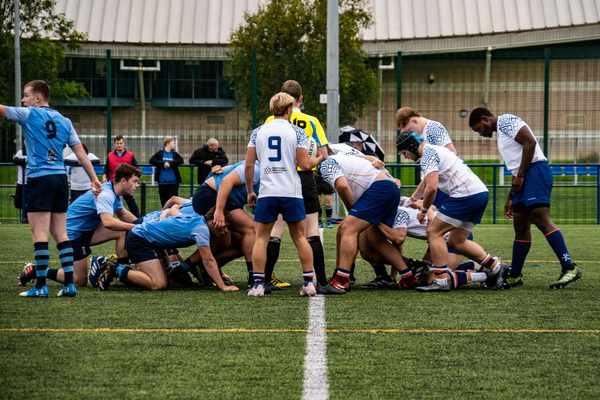
A sevens scrum has three players from each side, rather than eight. Teams must be ready within fifteen seconds of the referee’s mark. Scrums restart play after certain infringements, including many knock-ons and forward passes. With only three players committed, space remains across the field once the ball emerges.
What if the ball goes into touch?
Play is usually restarted by a lineout or, where permitted, a quick throw. Sevens follows rugby union principles with specific variations; not every tactical kicking reward used in fifteens applies.
After a penalty, the non-offending side can often tap and run, kick for territory or attempt a drop-kicked goal. A free-kick is different because it cannot score directly. Understanding rugby union penalties and scrum rules helps make these decisions easier to recognise.
Yellow Cards and Substitutions
A yellow card brings a two-minute temporary suspension in sevens, compared with ten minutes in standard fifteens. Playing six against seven on a full pitch is a major disadvantage. A red card removes a player from the match under the applicable laws.
Fresh substitutes can be crucial late in a match, especially at tournaments featuring several fixtures. Teams value players who can tackle, pass and cover open space as well as sprint.
How to Watch Your First Sevens Match
Try watching the space beyond the last defender rather than following only the ball. Notice when a team spreads wide and when defenders crowd around a tackle. At each restart, identify the kicker and see whether the chasers recover possession.
These observations reveal the format’s rhythm. They also show why learning rugby positions and roles helps only partly: sevens demands handling, tackling and decision-making from everybody.
Frequently Asked Questions
How many players are on a rugby sevens team?
Seven players from each team are on the field. Standard World Rugby laws allow up to five nominated and used replacements.
Are rugby sevens halves always seven minutes?
Ordinary matches have halves of up to seven minutes. Competition finals may use halves of up to ten minutes if the organiser chooses.
Does the scoring team kick off again?
Yes. The scoring team restarts with a drop-kick from halfway, an important difference from fifteen-a-side rugby.
Can a rugby sevens match end in a draw?
Pool matches can finish level under tournament regulations. Knockout fixtures needing a winner use golden-point extra time.
Final Thoughts
The rugby sevens rules create a thrilling balance between space, speed and precision. Seven-player teams, short halves, drop-kicked conversions and scoring-team restarts make every possession valuable. Learn the scoring, watch the open spaces and pay attention to restarts. Soon, the decisions behind each sudden break and late try become clear.