

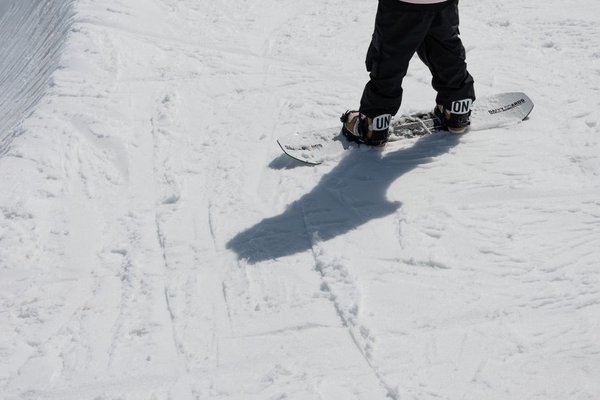
Before your first snowboard lesson, someone will probably ask a strange-sounding question: “Are you regular or goofy?” They simply want to know which foot you prefer at the front of your board. That choice affects your binding setup and how comfortable your first turns feel.
The regular vs goofy snowboard stance decision is easy to explain but not always obvious. A few tests can help, although your balance and confidence on snow provide the most useful answer.
Regular vs Goofy: What Is the Difference?
A regular snowboard stance places your left foot toward the board’s nose, with your right foot behind it. A goofy snowboard stance does the opposite: your right foot leads and your left foot stays toward the tail.
Neither stance is better. “Regular” does not mean correct, and “goofy” does not mean awkward. Both can support the same progression, from linking beginner turns to riding challenging terrain. Choose the orientation that helps you look ahead, stay balanced, and move comfortably.
The lead foot is the foot at the front during your usual direction of travel. You can also ride the other way, called riding switch, without changing your natural stance preference.
How to Find Your Natural Lead Foot
Treat an at-home snowboard stance test as a clue, not a verdict. People do not always use the same leg for kicking, balancing, and leading. Try more than one method and notice whether your answers agree.
Imagine sliding sideways
On clear, level, nonslip ground, stand with your feet about shoulder-width apart. Turn sideways and imagine gliding down a gentle slope. Which foot and shoulder do you instinctively put forward? Reset and try the reverse. One direction may make it easier to look ahead without twisting your body.
Notice your recovery step
When you naturally step forward to regain balance, notice which foot moves first. Repeat from a relaxed position without anyone pushing you or causing a fall. Some instructors use this as a lead-foot clue, but your recovery step can change with your starting position. It is not a definitive result.
Consider other board sports
If you skateboard or surf, the foot you normally place forward can suggest a snowboard starting point. Still, experience on another board does not guarantee the same preference on snow.
Kicking a football is also an imperfect shortcut. The foot you kick with reflects one kind of coordination; the planted foot reflects another. There is no universal rule that converts kicking-foot dominance into snowboard stance.
Let Beginner Terrain Settle the Question
If your tests disagree, tell your instructor you are unsure. On flat snow, they can help you experiment with basic movements before you commit to a longer run.
One useful exercise is skating with only your front foot strapped in while the free foot pushes on flat ground. With appropriate equipment adjustments and supervision, compare how stable you feel leading left versus right. Notice whether you can look ahead and stay centered over the board, rather than judging speed.
Next, compare short, controlled glides on suitable beginner terrain. Imagine that left-foot-forward felt natural at home, but right-foot-forward makes it easier to face your direction of travel and relax your shoulders. That repeated on-snow preference is more meaningful than a single living-room test.
Do not base the decision on one fall. New snowboarders often feel clumsy because stopping, edging, and balance are unfamiliar whichever foot leads. Look for a pattern over several gentle attempts.
Why Your Lead Foot Matters
When your preferred foot leads, it may be easier to look in the direction of travel and maintain a stable stance while you learn. The opposite orientation might encourage unnecessary body twisting. However, poor posture can also come from ordinary beginner habits, so changing stance is not a cure for every difficulty.
Lead-foot direction helps determine how bindings should be arranged. On a directional snowboard, the nose and tail may serve different purposes, so the setup matters. A symmetrical twin board is more adaptable, but it still needs a comfortable binding arrangement.
Stance also includes binding angles, width, and position along the board. These factors can affect comfort independently of regular or goofy direction. A beginner snowboard binding setup guide can help you understand the differences without changing everything at once.
Should You Change Your Bindings?
If you discover that the opposite lead foot feels better, ask a rental technician or instructor to check your equipment. Simply turning a directional board around may not provide the intended setup.
Start with a comfortable stance width and sensible beginner binding angles rather than copying an advanced rider’s extreme adjustments. Your anatomy, equipment, and instructor’s advice matter more than an exact number borrowed from someone else.
It helps to learn snowboard edge control basics before repeatedly adjusting the bindings. Otherwise, you may confuse a setup problem with the normal challenge of learning to turn.
Mistakes Beginners Can Avoid
One common mistake is assuming handedness determines stance. Right-handed riders may be regular or goofy, and the same is true for left-handed riders. Another is choosing regular merely because its name sounds more conventional.
Changing direction after every shaky attempt can interrupt learning too. Give each orientation enough supervised practice to notice a difference. Once one feels consistently better, focus on stopping, side slipping, and connecting turns.
Learning to ride switch is a later skill, not proof that your original stance was wrong. When you feel steady, a beginner snowboard turning guide is a useful next step.
Frequently Asked Questions
Is goofy snowboard stance harder than regular?
No. Goofy means your right foot leads. It does not describe difficulty or ability. Progress depends far more on balance, practice, instruction, and finding a comfortable setup.
Which foot goes forward if I am right-footed?
Either could. Foot dominance is not a reliable rule for everyone. Compare several movement clues and, ideally, test both directions on gentle snow.
Can I switch from regular to goofy later?
Yes. Some beginners change their initial choice after instruction. Have your equipment adjusted correctly and try the new direction on suitable terrain.
Is riding switch the same as being ambidextrous?
Not exactly. Riding switch means snowboarding with your less familiar foot leading. It is a learnable skill, regardless of which stance you naturally prefer.
Choose Comfort, Then Build Your Skills
Regular means left foot forward; goofy means right foot forward. Neither choice predicts how far you can progress. Begin with safe movement tests, then let repeated experience on beginner snow guide you.
Once one direction helps you balance, look ahead, and practise controlled stops, you have your starting stance. The next challenge is not finding a better label. It is learning to ride confidently.