

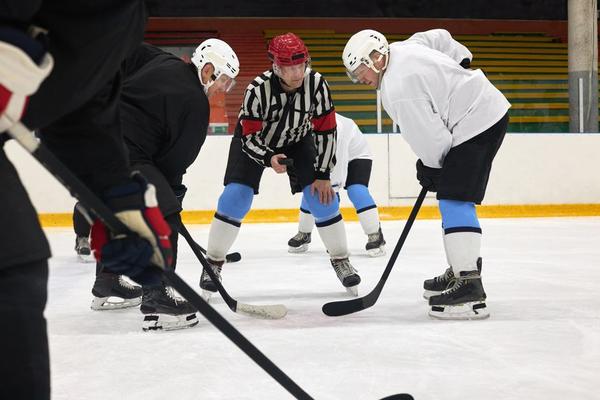
A hockey faceoff lasts only a moment, yet it can decide who controls the next shift. After a whistle, two opposing players meet over a dot while their teammates prepare for the puck to move. The location, lineup and first touch all matter. Once you understand how hockey faceoffs work, those frequent restarts become easier to read as small tactical battles rather than pauses in the action.
What Happens During a Hockey Faceoff?
An official drops the puck between two opposing skaters, usually centers, to start or resume play. Each player tries to direct it toward a teammate or useful space. The rest of the skaters react as soon as the puck is legally dropped.
A faceoff win is not necessarily a clean backward sweep. A center can tie up an opponent so a winger retrieves the puck, or push it forward when an opening appears. The real objective is possession that helps the team make its next play.
Where Do Hockey Faceoffs Happen?
A standard rink has nine designated faceoff spots: one at center ice, four in the neutral zone and four in the end zones, with two near each goal. The reason for the stoppage determines which spot is used. The following examples reflect common NHL situations; other competitions may apply different details.
Center Ice
The opening draw of each period and the restart after a goal take place at center ice. Neither team begins with the immediate territorial advantage of an end-zone draw.
Neutral Zone
The four neutral-zone dots sit near the blue lines. Offside stoppages often bring play outside the attacking zone, although the precise spot depends on the situation. Understanding ice hockey offside rules helps explain why an attack sometimes restarts farther from the net.
End Zones
Faceoffs near a goal are more dangerous. After a goalie covers the puck, the next draw commonly occurs in that team’s defensive zone. Icing also generally sends the puck to the offending team’s end. Under NHL icing rules, that team normally cannot change its players before the faceoff, which can leave tired skaters defending a critical draw.
Faceoff Positions and the Puck Drop
The two players taking the draw stand across from each other, facing the opponents’ end of the rink. Their feet and stick blades must meet the markings and positioning requirements. At end-zone circles, wingers wait outside the circle and behind the restraining lines; defensemen line up to receive the puck or defend the next play.
These faceoff positions reveal a plan. An attacking winger might prepare to recover a puck along the boards, while a defenseman stays available for a quick shot from the point. Defenders may arrange themselves to protect the slot or provide a clearing option. Knowing basic ice hockey player positions makes these assignments clearer.
Who Puts a Stick Down First?
In NHL play, the visiting skater puts their stick on the ice first at center ice. At the eight other spots, the defending skater places the stick first, followed by the attacker. The official then conducts the hockey puck drop. Stick-placement procedures differ among rulebooks: USA Hockey’s 2025–2029 rules, for example, use a different order for end-zone draws.
What Are the Main Hockey Faceoff Rules?
Once permitted substitutions are finished, the official signals teams to get ready. In ordinary NHL situations, players have a short five-second window to line up, with special handling late in regulation and in overtime. Centers cannot deliberately delay the restart while sizing up their opponents.
Before the drop, skaters must avoid early movement, illegal contact and encroachment into restricted space. A center must take the proper stance and keep the stick positioned as instructed. A teammate’s early step into the circle can create a violation even when the center is ready.
What Happens After Faceoff Violations?
Common faceoff violations include improper stick placement, premature movement, crowding the circle and delaying the lineup. An official may remove the offending center from the draw and have another eligible teammate already on the ice take it instead. If the puck was dropped unfairly, the official can order another draw.
A second violation by the same team during the same faceoff can lead to a bench minor penalty for delay of game. There are exceptions: after an NHL icing, the first faceoff violation generally brings a warning rather than removal of the center. Not every irregular drop means an immediate penalty, and youth or international competitions can differ in their procedures.
Why Faceoff Tactics Matter
Centers consider more than hand speed. They read their opponent’s grip, decide which side offers support and communicate with teammates about where the puck should go. A successful draw is a coordinated play, not an isolated one-on-one contest.
Pulling the Puck Back
The center sweeps the puck to a winger or defenseman. In the attacking zone, a defenseman may immediately shoot through traffic or pass across the blue line. The timing matters because defenders can close the shooting lane within seconds.
Tying Up the Opponent
Rather than trying to win cleanly, a center can occupy the opposing stick after the legal drop. A nearby winger then moves in for the loose puck. Teams use this when a straight pullback is unlikely to beat a stronger or quicker opponent.
Protecting a Late Lead
Picture a team leading by one goal with 40 seconds left. Its goalie freezes the puck, producing a defensive-zone faceoff. The center aims toward the boards, where a winger is ready to collect and clear it. Even a tie-up that prevents a quick shot from the slot can buy valuable time.
How to Watch a Faceoff More Closely
Before the next drop, check the location, then watch the wingers instead of staring only at the centers. Who is poised to skate toward the boards? Is a defenseman waiting for a pass? Follow the puck for another two seconds after the initial touch. That follow-up often determines whether a team can attack or must defend.
Frequently Asked Questions
Why does a center get removed from a faceoff?
An official can replace a center because of a positioning or timing violation, including early encroachment by a teammate. Another eligible player already on the ice takes the draw.
Can a winger take a faceoff?
Yes. A skater does not have to be listed as a center to take a draw. Teams sometimes use a winger when their usual center is unavailable or removed.
Can a goal be scored straight after a faceoff?
Yes. An attacking-zone win can produce an immediate shot, tip or rebound goal before the defending team reorganizes.
Does every stoppage restart at center ice?
No. Center ice is used for period starts and after goals, while most other stoppages lead to a draw at an appropriate neutral-zone or end-zone spot.
Why the Next Few Seconds Count
A faceoff is a short restart with consequences beyond the first touch. The chosen spot sets the risk, legal positioning shapes the options and coordinated teammates turn a draw into possession. Watch the recovery and first pass, and you will start seeing the tactical choices hidden inside every puck drop.